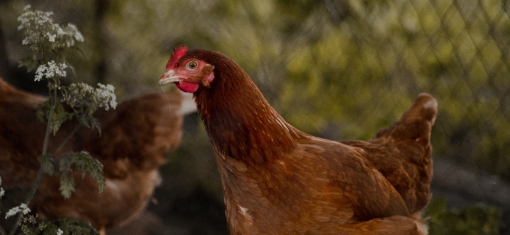



In summer, high temperatures become a real challenge for poultry.
Unlike humans, chickens do not sweat: they pant to regulate their heat. However, above 30°C, they reduce their feed intake, slow down egg production, and can even suffer from heat stress or exhaustion. For breeders, this is therefore a major issue for animal welfare, but also for profitability.
This article offers proven best practices, breeder tips, and discusses CABI Group solutions to get through the summer serenely with a healthy, productive, and vigorous flock.
1. Shade and ventilation: the fundamentals
Establishing shaded areas is essential:
- Outdoor runs: hedges, trees, shade nets, stretched canvases, or light structures.
- Fixed or mobile chicken coops: cross-ventilation morning and evening, opposing hatches, absence of translucent walls in direct sunlight (opaque blue walls are preferred, as translucent walls amplify the heat effect and chicken stress).
- Open your roof lanterns to the maximum; as hot air accumulates at the top, it will be better evacuated. If you do not have roof lanterns, they can be installed on existing buildings.
- The orientation of a mobile chicken coop like the CABI ORIGIN M or the CABI MOOV can be optimized to capture prevailing winds and benefit from natural shade during the day.
Reference: ITAVI recommends orienting buildings according to prevailing winds to promote summer thermal comfort (climatbat.chambres-agriculture.fr).
2. Hydration: abundant, fresh, and clean water
Water remains a pillar for getting out of critical situations:
- In summer, daily needs can double, reaching 400–500 ml per hen.
- Install several drinkers, clean them every day, and place them in the shade.
- Change the water several times a day during heat peaks.
Reference: INRAE emphasizes the importance of maintaining constant water consumption to avoid heat stress (MDPI, climatbat.chambres-agriculture.fr).
3. Feeding: an easy-to-digest ration
- Distribute food early in the morning and late in the evening, when the temperature is milder.
- Ensure you use digestible feed
- Supplement exceptionally with vitamins and electrolytes during periods of intense stress.
Reference: the Brittany Chamber of Agriculture recommends these rations during periods of high heat (climatbat.chambres-agriculture.fr, site.extension.uga.edu).
4. Passive cooling: simple and effective techniques
A few proven tips help cool the chicken coop environment:
- Watering the ground around the enclosure or building to promote evaporation.
- Low-pressure misting: ventilate afterward to avoid stagnant humidity.
- Light-colored roofing: increased reflectivity = a drop of several degrees measured by ITAVI.
Reference: ITAVI recommends passive cooling devices including paint and misting (climatbat.chambres-agriculture.fr).
5. Watering the building roof: an eco-energy practice to know
Some breeders regularly water the roof of their chicken coop in the afternoon, creating an evaporative effect that cools the indoor air by several degrees.
- This technique is commonly used in other agricultural or industrial buildings, particularly metal roofs, where the temperature can drop by 5 to 10°C (Reddit).
- If the roofs are well insulated, the impact is less; but on metal or uninsulated roofing, the effect is notable.
- The water used can be recovered or recycled via a system of gutters and a pump.
- Be careful, however, of waterlogged soil around the chicken coop: maintain a balance to avoid excessive humidity.
Well-managed, this system can advantageously complement passive ventilation and maintain a cooler indoor environment for your chickens.
.
6. Flock monitoring: detecting signs of heatstroke
Be attentive to abnormal behaviors:
- Intense panting, wings held away from the body, immobile posture, lethargy, loss of appetite, cessation of laying.
- In case of suspicion, isolate the bird, offer it fresh water, shade, or even a foot bath.
Reference: the DGAL (Ministry of Agriculture) recommends these emergency actions in case of acute heat stress (climatbat.chambres-agriculture.fr).
7. Heatwave checklist: everything at a glance
Action |
Natural or artificial shaded areas |
Morning/evening cross-ventilation |
Multiple drinkers, renewed water |
Adapted feeding (flakes, vitamins) |
Watering the ground and/or roof |
Close monitoring of behavior |
Why |
Reduce direct heat |
Cool and renew the air |
Constant hydration |
Easier digestion |
Lower the ambient temperature |
Prevent heatstroke |
8. Why these practices work (scientific basis)
a) Natural ventilation and evaporation
Passive temperature lowering by evaporation works particularly well with regular airflows. Cooling the ground or the roof activates a favorable thermal cycle.
b) Roof watering
If used moderately (a few intermittent minutes), this system can reduce internal temperatures. Well-documented in greenhouse architecture (Reddit, MDPI, climatbat.chambres-agriculture.fr), it finds similar applications in agricultural buildings, even if few publications specifically target poultry.
c) Targeted misting
Standard misting systems can reduce ambient humidity, especially when air circulates well. Their effectiveness depends on correct dosage and subsequent ventilation.
d) Evaporation on birds (“sprinkling”)
American studies (Mississippi State University, University of Arkansas…) show that spraying water directly on birds (in brief sessions, in cycles) effectively reduces heat stress, with water consumption up to 60–70% lower than traditional systems (Poultry World, Extension MS, The Poultry Site, aaes.uada.edu).
9. Customer testimonials (real examples)
I installed a sprinkler on the roof of my chicken coops. I activate it for 5 minutes, three times in the afternoon. Result: a drop of 3 to 4°C measured inside. My chickens stay active longer.
I combine shade, shaded drinkers, gentle misting, and mobile orientation of the CABI chicken coop according to the wind: my feed consumption remains stable despite 20 days at over 35°C!
In summary: the winning summer combo
- Shade, natural ventilation, optimal orientation.
- Multiple drinkers, renewed fresh water, impeccable hygiene.
- Adapted feeding + vitamins if needed.
- Passive cooling: ground, painted roof, misting.
- Moderate roof watering in case of high heat.
- Regular observation of the flock to anticipate any signs of stress.
- Suitable CABI equipment: ventilation, mobile chicken coops